
Using magnetic susceptibility to study rocks and sediments helps researchers trace mineral changes, compare layers and investigate how deposits formed. It is a rapid screening measurement whose meaning is checked against mineralogy, sediment description and the history of the material.
A Magnetic Fingerprint of Geological Material
Rocks and sediments contain varying mixtures of weakly and strongly magnetic minerals. Susceptibility provides a repeatable way to compare these mixtures. A sequence of readings highlights changes that may be subtle in colour or texture, helping researchers select positions for detailed sampling.
The fingerprint is not unique. Different mineral combinations can yield similar bulk values, and a little magnetite may dominate a large mass of other material. Susceptibility is one property within a geological description rather than a standalone mineral identification or automatic classification of rock type.
Comparing Igneous and Sedimentary Rocks
In igneous rocks, susceptibility may reflect the abundance and alteration of iron-bearing accessory minerals. Changes across an outcrop can help investigate variation within a body or later weathering. Measurements need representative surfaces because a weathered rind may differ from fresh material underneath.
Sedimentary rocks record transport, deposition and subsequent change. Magnetic grains may be inherited, concentrated by sorting or formed after burial. The same sediment type can consequently have contrasting values in different settings. Explanation requires its environment and alteration history as well as the reading.
Tracing Sediment Sources and Transport
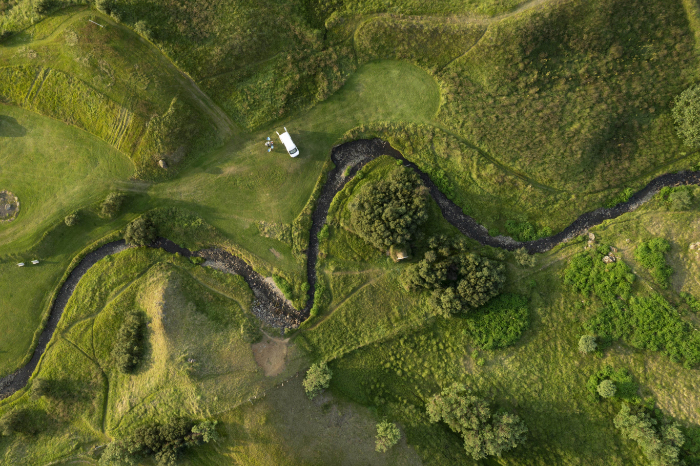
A river mixes material from several catchment sources. If those sources differ magnetically, susceptibility can help investigate changes in their contributions downstream or through a core. It may indicate where fine particles accumulated or erosion introduced a different soil horizon.
Local comparison samples are essential. Sorting can change magnetic concentration without a new source, while dilution by quartz, carbonate or organic material can lower a reading. Researchers test whether a change follows texture, mineralogy or source composition before assigning it to a particular erosion event.
Logging Cores and Correlating Layers
Core logging gives measurements at known positions. Distinctive peaks and trends can help compare nearby cores and identify boundaries for analysis. Core diameter, sensor size, spacing and sample condition affect resolution and should remain consistent where possible.
A matching peak does not prove two layers share an age: similar material may arrive at different times. Gaps, disturbed samples and changed core geometry also affect the trace. Independent stratigraphy and dating test a suggested correlation rather than assuming the magnetic pattern establishes it.
Read related articles:
The Physics Behind Magnetic Susceptibility
What Magnetic Susceptibility Surveys Reveal
Loess and Ancient Soil Formation
Loess is wind-deposited sediment that can preserve intervals of soil development. Magnetic minerals form or change during these intervals, contributing evidence about past environmental conditions. The relationship between enhancement and climate depends on regional processes, so a calibration cannot simply be transferred between continents.
A March 2025 study compared loess susceptibility at 15 alternating-field frequencies and examined a sequence in Tajikistan. Broader frequency measurements improved information about fine particles compared with the usual two-frequency approach. This refines an environmental proxy; it does not create a universal conversion to rainfall. Source: Schneider and colleagues, 2025.
Frequency Dependence Adds Another Dimension
Changing frequency reveals responses associated with very fine magnetic particles. Comparing low and high frequencies investigates whether part of the signal varies over the instrument’s timescale. Results need a stated calculation and frequency pair so different studies can be compared properly.

This may distinguish soil-forming contributions from coarser inherited grains, but mixtures remain complicated. A low percentage can reflect coarse material, weak signal or dilution; a higher percentage still needs an explanation. Remanence measurements and thermal tests can provide independent information about mineral type and grain behaviour.
Burial Can Rewrite the Magnetic Record
After deposition, oxygen conditions and pore-water chemistry may dissolve magnetic minerals or form new ones. Diagenesis can weaken or alter a signal originally recording sediment supply. A quiet layer might therefore reflect mineral loss rather than reduced erosion.
Researchers examine relationships with organic content, colour, sulphides and other alteration indicators. If the magnetic pattern follows a chemical boundary, its meaning differs from that of a primary depositional layer. This distinction matters when building an environmental history from the sequence.
Separate Magnetic Concentration from Sediment Dilution
Imagine two hypothetical layers receiving the same amount of magnetic material, but one also receiving much more non-magnetic carbonate. The carbonate-rich layer can have lower mass-specific susceptibility because the magnetic contribution is diluted across a greater total mass. That reduction does not necessarily mean the magnetic sediment source became less active. It may reflect a change in the material deposited alongside it.
To investigate this possibility, compare susceptibility with carbonate content, dry bulk density, grain-size measurements and other magnetic parameters. A stronger association with dilution than with sediment source changes would support a different interpretation of the profile. This example is conceptual rather than a reported case from a customer site. Its purpose is to show why a curve needs supporting measurements: the same downward trend can arise from reduced magnetic input, dissolution after burial or greater input of weakly magnetic material. Each explanation has different implications for the environmental history.
A Reproducible Sampling Workflow
Begin with a geological question and sampling plan. Record position and depth, describe the sediment, avoid magnetic contamination and keep preparation consistent. Include blanks and calibration checks, and explain whether results are normalised by volume or dry mass. Retain material for follow-up analysis where the first measurements identify uncertainty.
Field topsoil mapping differs from laboratory core analysis. The service described by Pre-Construct Geophysics focuses on shallow prospecting for variation relevant to past activity. Discuss sample type and analytical requirements explicitly for a rock or sediment project; the appropriate sensor and laboratory work depend on its question.
Summary
Susceptibility connects changes in mineralogy, sediment supply and soil development through a geological sequence. Combining it with texture, stratigraphy and alteration evidence makes the profile useful, while climate and provenance conclusions remain hypotheses to test with independent data.
Find out how Pre-Construct Geophysics uses magnetic variation in site prospecting, and discuss your investigation’s scope before choosing an approach.
Magnetic Susceptibility Surveyor